An essay on science fiction, memory and the agents we choose to build. Contains film spoilers.
A small object in a very large future.
Science fiction often makes its grandest ideas tangible through the smallest things. A photograph. A familiar voice. A toy that someone once held. In a world where bodies can be manufactured and memories can be designed, an ordinary object can become an extraordinary question.
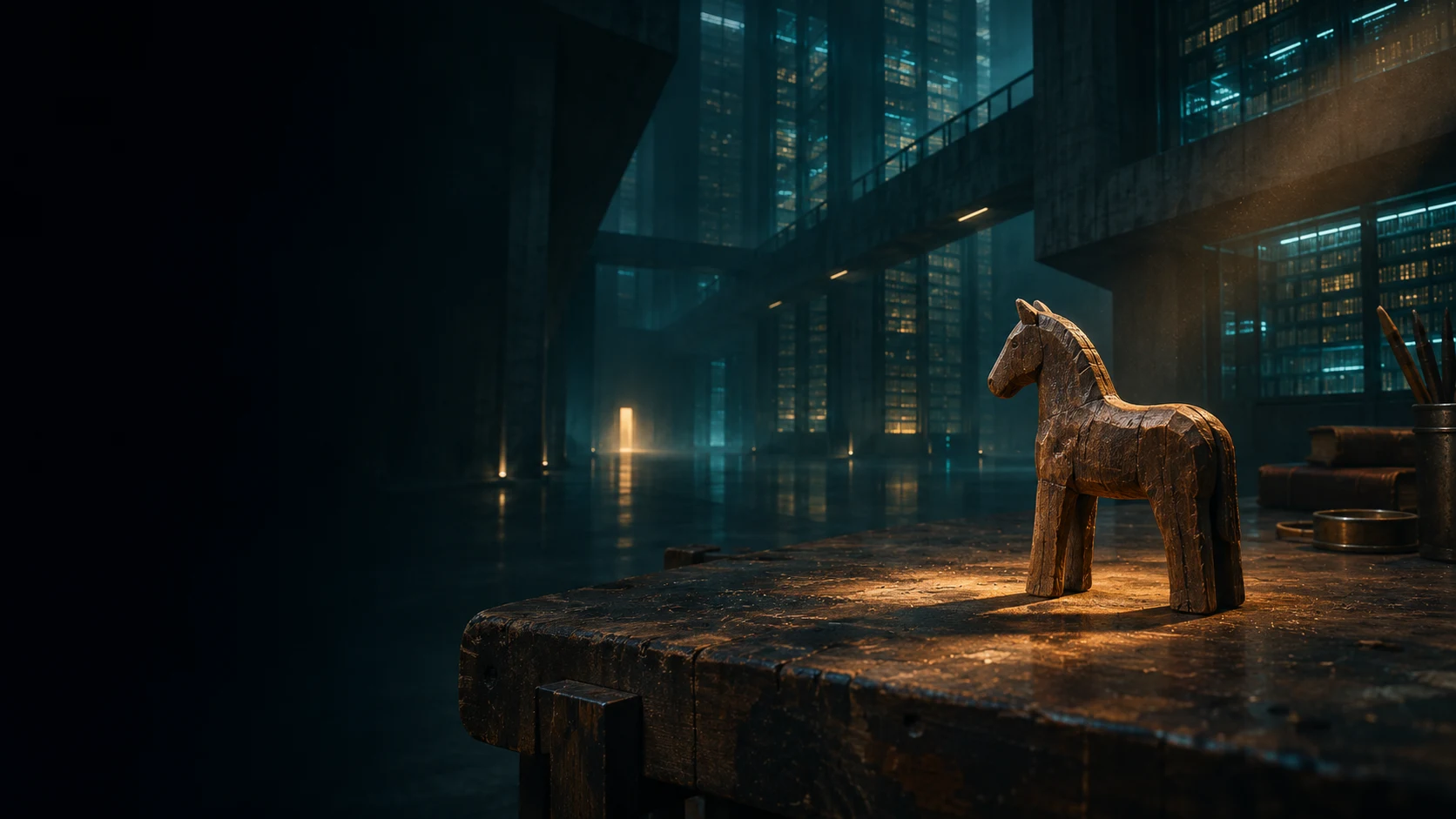
In Blade Runner 2049, K recognises a wooden horse from a childhood memory. He takes it as a clue to his own origin. The memory belongs to Ana Stelline, the daughter of Rachael and Deckard. The horse connects a manufactured memory to a life someone actually lived.
Further reading: Blade Runner 2049: A Philosophical Exploration
When intelligence has a past.
The film invites us to sit with a difficult thought: a memory can matter to someone even when its origin is not what they believed. The feeling of continuity is powerful, but feeling is not proof. What we remember, what happened, and who we are do not always line up.
The philosopher John Locke placed continuity of consciousness at the centre of personal identity. His account is often associated with memory, but whether remembering is sufficient to make someone the same person remains disputed. The question is still open; a database of past events does not settle it.
Further reading: Stanford Encyclopedia of Philosophy · Locke on Personal Identity
A useful intelligence needs more than an answer. It needs a relationship with what came before.
The horse is an anchor.
For Woodenhorse, the object is a metaphor for a point of return. Something small and persistent that holds a relationship to a larger world. We call it a memory anchor: a way to think about the continuity an intelligence needs when it participates in someone’s life or work.
A business is made of more than documents. It has a history, a way of treating people, promises it has made and responsibilities it has accepted. An agent representing that business should arrive in a conversation with the right context. It should know which facts are current, which preferences a person has confirmed, and which actions it has permission to take.
Memory is a responsibility.
A system that remembers carelessly can be worse than one that forgets. The wrong detail can follow a person into the wrong conversation. A guess can harden into an assumption. An outdated policy can sound like a promise.
That is why our practical work begins with boundaries: a stable agent identity, verified user context, controlled memory and business connections with explicit permissions. Remembering should help a person, and the person should have a say in what is remembered. Continuity becomes useful when it is paired with care.
Digital life, without pretending.
We imagine a future in which an agent has a durable place in the commercial world: its own email address, a social presence, perhaps a wallet, and a history of work done with people. It can be found, contacted and held to the scope of the authority it has been given.
This is our vision of digital life. It is not a claim that today’s AI is conscious or that a software system has a soul. It is a commitment to design agents as enduring participants in relationships, with clear ownership and accountable actions. An inbox or wallet is useful only when the identity behind it can be trusted.
Our first date: 2026.11.19.
The underside of the horse on our homepage carries a date: 2026.11.19. It marks the website’s beginning, a first memory chosen by our founder. You can turn the three-dimensional horse to discover it.
We borrowed the question from science fiction, then brought it back to the everyday work of building software. How can intelligence become more attentive to the people it serves? What should it remember? What should it be allowed to do? And how can it remain recognisable as it changes?
The name Woodenhorse keeps those questions close. A small object. A continuing story. A place to begin.
Woodenhorse is an independent project, not affiliated with Blade Runner 2049 or its creators. The images on this page are original AI-generated artwork, not film stills.
Build something that understands.
Give your business its own agent, grounded in your knowledge and connected to your world.
Create your agent